
Why Trump wants to rename AI "Super Intelligence": a dated timeline
What was said, when, on which platform, and what has actually changed. Kept as a neutral record and updated as the story develops.
In short: Over four days in September 2026, President Trump proposed renaming artificial intelligence, ran two polls on Truth Social, settled on “Super Intelligence”, and then told the United Nations that US government documents would use that term from now on. The technology has not changed. The word “superintelligence” already had a different, narrower meaning in AI research, and still does. This page records what was said and when; it does not take a view on whether the rename is a good idea.
The timeline
Saturday 19 September 2026: the first poll
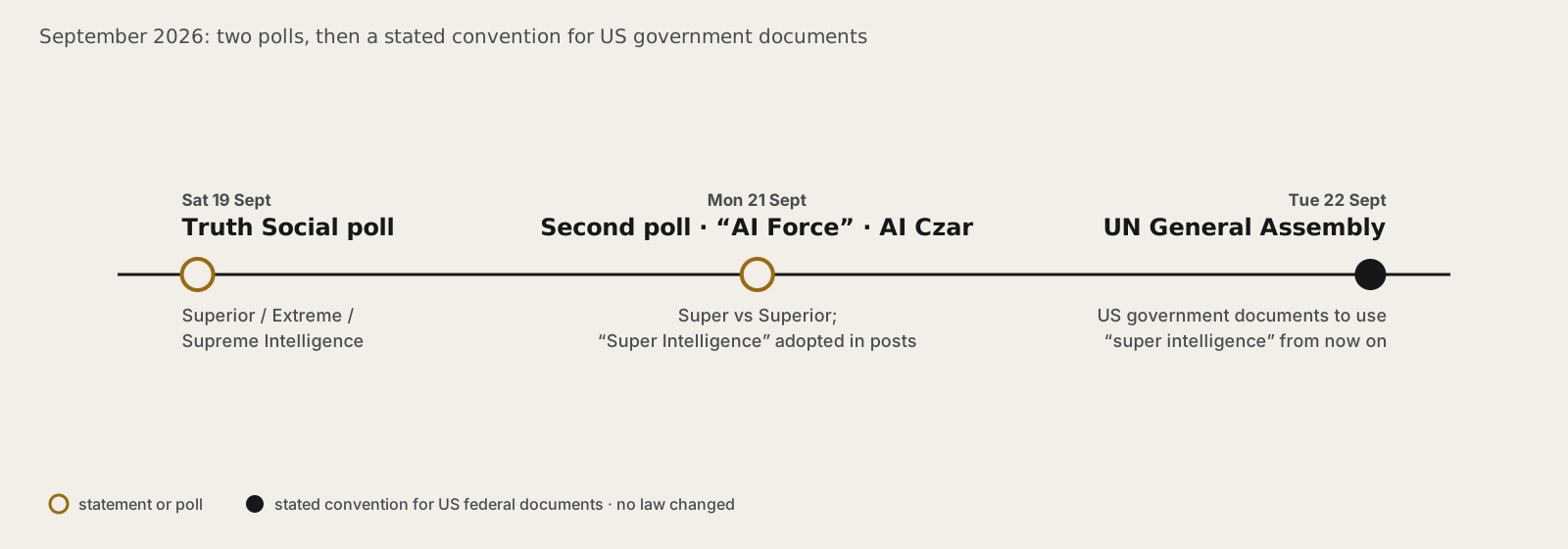
On Truth Social, the President wrote that “many people think that the words ‘Artificial Intelligence’ are inaccurate, and very ineloquent”, and proposed three alternatives he called more “elegant and accurate”: Superior Intelligence (SI), Extreme Intelligence (EI) and Supreme Intelligence (SI). He asked followers to vote.
The same day, in a separate post, he described what he called a campaign to “decimate” American AI, linking it to earlier opposition to data centres, and said he would not “stand by and let it happen”.
Monday 21 September 2026: the second poll, the AI Force and an AI Czar
A second Truth Social post narrowed the choice to “SUPER INTELLIGENCE” versus “SUPERIOR INTELLIGENCE”. Subsequent posts used “Super Intelligence” and the initials “SI”.
In the same period he announced two new things. First, that he was “forming the AI Force, much like I did Space Force, which has been a tremendous SUCCESS, in my First Term”. Second, that he would appoint an AI “Czar”, adding that “Only High I.Q. individuals need apply!” Neither the AI Force’s remit nor the Czar’s role had been set out in any published document at the time of writing.
Tuesday 22 September 2026: the UN General Assembly
In his address to the UN General Assembly in New York, the President said that US government documents would use the term “super intelligence” going forward instead of “artificial intelligence”. He also said the United States leads and would continue to lead the technology’s development, repeated his view that fears about AI were overblown, said he would monitor the industry “closely through the Department of Justice”, and said he opposed new regulation of it.
Tuesday 22 September 2026: the White House publishes the wording
The same day, the White House published a press release on the speech, “President Trump at the United Nations: ‘While Others Have Talked, I Have Acted’”. It quotes the President as follows: “The United States totally rejects any attempt to construct a globalist scheme of control for the Artificial Intelligence being spoken of so much now — hereinafter officially called ‘Super Intelligence.’”
This is a different kind of evidence from the news reports of the speech: it is the White House itself reproducing and publishing the wording. It is not, however, an executive order, a directive to agencies or a federal style guide, and the release does not mention any. It establishes that the White House has published the term “officially called ‘Super Intelligence’”; it does not establish that the term has been adopted across US government documents.
What has actually changed
- A stated convention for US federal documents, published by the White House. The President stated it in the UN speech and the White House’s press release of 22 September 2026 reproduces the wording “hereinafter officially called ‘Super Intelligence.’” Whether agencies adopt it, and how quickly, is not yet known.
- Nothing in law. As of 23 September 2026, we found no statute, executive order, directive or federal style guide implementing the change: nothing dated 19–23 September on artificial intelligence, “Super Intelligence”, an AI Force or an AI czar appears among the presidential actions published on whitehouse.gov, and the White House release itself refers to none. If one appears, it will be added here.
- Nothing outside the US government. At the time of writing, no other government, regulator or standards body had adopted the term. The UK’s AI Security Institute has not changed its name.
- Nothing about the technology. The systems people use (chatbots, image generators, coding assistants) are the same systems they were on 18 September.
Why the choice of word matters
The word “superintelligence” was not free for the taking. It has a specific meaning in AI research going back at least to the philosopher Nick Bostrom’s 2014 book Superintelligence: Paths, Dangers, Strategies: an intellect that greatly exceeds the cognitive performance of humans in virtually all domains. That is a hypothetical future system, not a description of anything that exists today, and a large part of the academic and policy debate about AI risk is about whether and when such a system might be built.
Using the same word for ordinary present-day AI therefore creates an ambiguity. When a UK reader now sees “super intelligence” in a headline, it may mean either. This site keeps the two apart: we say “AI” for the technology in general use, and “superintelligence” only in the research sense, and we flag the administration’s usage explicitly where it comes up. Our explainer on the difference is here.
What people have said in reply
This page does not adjudicate the reaction, but records what has been reported. Coverage sympathetic to the President has framed the rename, together with the AI Force, as part of a push for American leadership in the technology and a rejection of what it calls the “AI establishment”. Some social-media users responded to the poll by suggesting “American Intelligence” instead. UK technology press has described the move as a proposed rebranding rather than a technical redefinition of the term, noting that “superintelligence” already has an established meaning in the work of Nick Bostrom and others. The announcements came during a period of renewed public argument about AI safety, following the resignation of an Anthropic researcher over safety concerns and a subsequent plan by Anthropic’s chief executive to “pace the frontier”.
What we are watching
- Whether a formal directive to federal agencies is published, and what it says; and, separately, whether the term begins to appear in federal documents in practice.
- Whether the AI Force and the AI Czar are given a remit, a budget and a name.
- Whether any UK body (government, regulator or institute) adopts the term.
- How the major AI companies refer to their own products in US filings and announcements.
This page is reviewed monthly, or sooner when something changes. The “what changed” list at the foot of the page records every substantive edit.
Sources
- The White House, “President Trump at the United Nations: ‘While Others Have Talked, I Have Acted’”, press release, 22 September 2026: “hereinafter officially called ‘Super Intelligence.’” Primary source for the UN wording.
- Reuters, “Trump says US will henceforth call AI ‘super intelligence’”, United Nations, 22 September 2026: via Yahoo News and 933thedrive.com.
- TechCrunch, “Trump says it’s time to rebrand AI with a new name — and he’s also creating an AI Force”, 19 September 2026.
- Unite.AI, “Trump Proposes Renaming Artificial Intelligence, Announces AI Force”, 19 September 2026.
- IBTimes UK, “Trump Wants To Rename AI ‘Super Intelligence’, Calling ‘Artificial’ Inaccurate as He Plans AI Force and Czar”, 22 September 2026.
- Crowdfund Insider, “President Trump Renames Artificial Intelligence, Super Intelligence At UN Speech”, 22 September 2026.
- CDM, “Trump Creates ‘AI Force,’ Names AI Czar, And Wants To Rename ‘Artificial’ Intelligence”, 21 September 2026.
- Washington Times, “Trump renames artificial intelligence as ‘super intelligence’”, 22 September 2026.
- Nick Bostrom, Superintelligence: Paths, Dangers, Strategies (Oxford University Press, 2014).
The President’s Truth Social posts of 19 and 21 September are the primary sources for those dates. Quotations from them are given as reported by the outlets listed above.
Common questions
- Has AI officially been renamed?
- Only in one sense. On 22 September 2026 President Trump said at the UN that US government documents would use "super intelligence" rather than "artificial intelligence" from now on, and the White House's own press release on the speech, published the same day, refers to artificial intelligence as "hereinafter officially called 'Super Intelligence.'" That is a stated convention, published by the White House. As of 23 September 2026 we found no executive order, directive or federal style guide implementing it, no evidence of the term in use across federal documents, and no other government or standards body that had adopted it.
- Is "Super Intelligence" the same as superintelligence?
- No. The administration is using "Super Intelligence" as a new name for artificial intelligence in general. In AI research, "superintelligence" has meant, since at least Nick Bostrom's 2014 book, an AI that substantially exceeds the best human minds at nearly every task. That does not exist yet.
- What is the "AI Force"?
- A body President Trump announced on Truth Social on 21 September 2026, which he said would be modelled on the US Space Force. Its authority, funding and responsibilities had not been set out publicly at the time of writing.